
What Is Pet Insurance Reimbursement?
Pet insurance reimbursement is the money your insurer pays you back for covered vet bills. Most plans work this way: you pay the vet, file a claim, and get a share of the bill back once your deductible is met. How much you get back depends on four things: the covered bill, your deductible, your reimbursement rate and your annual limit. The order your insurer applies them in also matters, and that is where most pet parents get confused.
Quick answer: With a $2,000 covered vet bill, a $500 deductible and 80% reimbursement, you get back $1,200 if your insurer subtracts the deductible first, or $1,100 if it applies the reimbursement rate first. The examples below show the math step by step.
Key Pet Insurance Reimbursement Terms
These five terms decide what lands back in your bank account. See our full list of pet insurance terms and definitions for more.
| Term | Definition |
|---|---|
| Annual Limit | The maximum amount your pet insurance will reimburse you for covered veterinary expenses in one policy year. Among the insurers we compare, options range from $2,000 to unlimited. Choose a limit high enough to cover a major illness or surgery. |
| Co-Insurance | Another name for your reimbursement rate. It's the percentage of your eligible veterinary expenses that your insurance provider pays you back after you've met your deductible. |
| Co-Pay | The portion of your eligible veterinary expenses that you're responsible for after you've met your deductible. It's the flip side of your reimbursement rate: 100% minus your rate. For example, an 80% reimbursement rate means a 20% co-pay. |
| Deductible | The amount you pay out of pocket each policy year before your insurance starts reimbursing you. A higher deductible lowers your monthly premium but raises what you pay before coverage kicks in. Among the insurers we compare, options range from $50 to $5,000, with $100 to $1,000 most common. |
| Reimbursement Rate | Sometimes called "co-insurance," this is the percentage of your eligible veterinary expenses that your insurance provider pays you back after you've met your deductible. The most common options are 70%, 80% and 90%. |
Most insurers offer reimbursement rates of 70%, 80% or 90%. Some go as low as 50% or as high as 100%. Annual, per-incident, or lifetime limits cap your total payout, no matter how high your rate is.
How Does Pet Insurance Reimbursement Work?
You pay the vet first, then your insurer pays you back for the covered part of the bill. Here is the usual process:
- Your pet gets treatment and you pay the clinic in full.
- You ask for an itemized invoice.
- You submit a claim online, in the insurer's app or by mail, with the invoice and any medical records requested.
- Your insurer reviews the claim and calculates your reimbursement.
- If approved, you get a check or direct deposit.
Many pet parents are reimbursed within 5 to 10 business days of submitting a complete claim. Digital claims and direct deposit are usually fastest.
Avoid these common claim mistakes:
- Filing late. Most insurers set a deadline, such as 90 days from the vet visit.
- Missing paperwork. Always include an itemized invoice and any records your insurer asks for.
- Assuming everything is covered. Accident and illness plans usually exclude routine care unless you add a wellness plan.
How Pet Insurance Reimbursement Is Calculated
Pet insurers calculate reimbursement in one of three ways. All three examples below use the same numbers so you can compare them: a $2,000 covered vet bill, a $500 deductible you haven't met yet, and 80% reimbursement (a 20% co-pay).
Method 1: Deductible First, Then Reimbursement Rate
This method gives you the most money back on the claim that meets your deductible.
- Start with the covered vet bill.
- Subtract any deductible you haven't met yet this policy year.
- Multiply the remainder by your reimbursement rate. The result is what your insurer pays you, up to your annual limit.
| Step | Amount |
|---|---|
| Covered vet bill | $2,000 |
| Subtract the $500 deductible | − $500 = $1,500 |
| Apply 80% reimbursement | × 80% = $1,200 |
| You get back | $1,200 |
| You pay | $800 |
Method 2: Co-Pay First, Then Deductible
Here your insurer takes your co-pay off the whole bill first, then subtracts the deductible from its share.
- Start with the covered vet bill.
- Subtract your co-pay (100% minus your reimbursement rate). What's left is your insurer's share.
- Subtract any deductible you haven't met yet. The result is what your insurer pays you, up to your annual limit.
| Step | Amount |
|---|---|
| Covered vet bill | $2,000 |
| Subtract your 20% co-pay ($400) | − $400 = $1,600 |
| Subtract the $500 deductible | − $500 = $1,100 |
| You get back | $1,100 |
| You pay | $900 |
Method 3: Co-Insurance First, Then Deductible
Some insurers call your share "co-insurance" instead of a co-pay. The math works the same way as Method 2. The insurer applies its percentage to the full bill, then subtracts the deductible.
- Start with the covered vet bill.
- Multiply the bill by your insurer's share (your reimbursement rate). Your co-insurance is the rest.
- Subtract any deductible you haven't met yet. The result is what your insurer pays you, up to your annual limit.
| Step | Amount |
|---|---|
| Covered vet bill | $2,000 |
| Insurer pays 80%, you pay 20% co-insurance | × 80% = $1,600 |
| Subtract the $500 deductible | − $500 = $1,100 |
| You get back | $1,100 |
| You pay | $900 |
How Each Pet Insurance Company Calculates Reimbursement
| Insurer | Calculation Method | Reimbursement Rates | Deductibles |
|---|---|---|---|
| ASPCA | Deductible first | 70%–90% | $100–$1,000 |
| Embrace | Deductible first | 70%–90% | $100–$1,000 |
| Fetch | Co-pay first | 70%–90% | $300–$700 |
| Figo | Co-insurance first | 70%–100% | $100–$750 |
| Healthy Paws | Co-insurance first | 50%–90% | $100–$5,000 |
| Lemonade | Co-insurance first | 70%–90% | $100–$750 |
| Pets Best | Co-insurance first | 70%–90% | $50–$1,000 |
| Prudent Pet | Co-pay first | 70%–90% | $100–$1,000 |
| Pumpkin | Deductible first | 80%–90% | $100–$1,000 |
| Spot | Deductible first | 70%–90% | $100–$1,000 |
Insurer details as of November 12, 2026. Options may vary by location, pet age, pet breed, and deductible configuration.
At 100% reimbursement, the order doesn't change your payout, because there's no co-pay to apply before or after the deductible. Compare quotes from these insurers to see your actual options.
More Pet Insurance Reimbursement Examples
Example 1: A $10,000 Emergency Surgery
Your dog needs life-saving surgery that costs $10,000. Your plan has a $200 deductible and 90% reimbursement (a 10% co-pay).
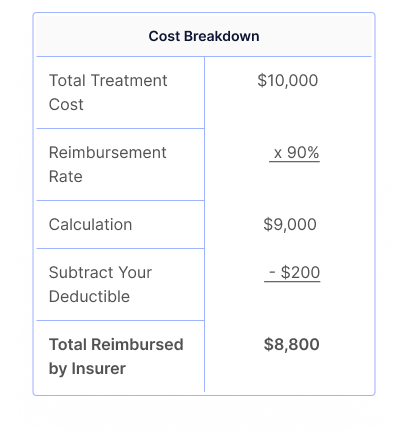
This example applies the 90% reimbursement rate first, then subtracts the $200 deductible. An insurer that subtracts the deductible first would pay back $8,820. Either way, insurance covers about 88% of a $10,000 bill you might otherwise have to decline.
Example 2: Three Claims in One Policy Year
Your cat has three covered vet visits in one year. Your plan has a $500 deductible, 80% reimbursement and applies the deductible first.
| Claim | Covered bill | Deductible applied | You get back | Deductible left |
|---|---|---|---|---|
| Ear infection | $300 | $300 | $0 | $200 |
| Urinary blockage | $1,000 | $200 | $640 | $0 |
| Dental extraction | $600 | $0 | $480 | $0 |
| Year total | $1,900 | $500 | $1,120 |
You pay $780 for the year: your $500 deductible plus 20% of the remaining $1,400. Once your deductible is met, each later claim pays a flat 80%.
Example 3: Hitting Your Annual Limit
Your dog's cancer treatment costs $8,000. Your plan has a $250 deductible, 90% reimbursement and a $5,000 annual limit.
| Step | Amount |
|---|---|
| Covered vet bill | $8,000 |
| Subtract the $250 deductible | − $250 = $7,750 |
| Apply 90% reimbursement | × 90% = $6,975 |
| Cap at the $5,000 annual limit | $5,000 |
| You get back | $5,000 |
| You pay | $3,000 |
A high reimbursement rate can't pay past your limit. If your pet is prone to costly conditions, a higher or unlimited annual limit may matter more than an extra 10% reimbursement.
How to Choose the Right Reimbursement Rate and Deductible
An 80% reimbursement rate is balanced for most pet parents. It covers most of a big bill while keeping your monthly premium manageable.
A higher reimbursement rate or lower deductible means a higher premium but less out of pocket at the vet. A lower rate or higher deductible saves on premiums but leaves you paying more when your pet gets sick or hurt.
How Your Reimbursement Rate Changes Your Payout
$3,000 covered bill, $500 deductible, deductible applied first.
| Reimbursement rate | You get back | You pay |
|---|---|---|
| 70% | $1,750 | $1,250 |
| 80% | $2,000 | $1,000 |
| 90% | $2,250 | $750 |
How Your Deductible Changes Your Payout
$3,000 covered bill, 80% reimbursement, deductible applied first.
| Annual deductible | You get back | You pay |
|---|---|---|
| $250 | $2,200 | $800 |
| $500 | $2,000 | $1,000 |
| $1,000 | $1,600 | $1,400 |
Ask yourself two questions: what can you comfortably pay each month, and what could you pay at the vet tomorrow?
Compare pet insurance quotes to see how each reimbursement rate and deductible changes your premium.
Pet Insurance Reimbursement FAQs
How do you calculate pet insurance reimbursement?
Subtract any unmet deductible from the covered bill, then multiply by your reimbursement rate. For a $2,000 bill, $500 deductible and 80% rate, that's ($2,000 − $500) × 80% = $1,200. Some insurers apply the rate first, which gives ($2,000 × 80%) − $500 = $1,100.
What is a good reimbursement rate for pet insurance?
80% is a good balance for most pet parents. It covers most of a large bill without the higher premium of a 90% plan.
Is a co-pay the same as co-insurance in pet insurance?
Yes, in most pet insurance plans. Both describe the percentage of a covered bill you pay, which is 100% minus your reimbursement rate. A 20% co-pay or co-insurance means 80% reimbursement.
Does a higher reimbursement rate cost more?
Yes. A higher reimbursement rate raises your monthly premium because your insurer pays more of each claim. A lower rate lowers your premium but raises your out-of-pocket costs.
How long does pet insurance reimbursement take?
Many pet parents get reimbursed within 5 to 10 business days of submitting a complete claim. Filing digitally and choosing direct deposit usually speeds things up.
Does reimbursement cover routine and preventive care?
Not on most accident and illness plans. Optional wellness plans cover routine care, but they usually pay a set amount per service with an annual cap.
What is direct vet pay?
Direct vet pay means your insurer pays the clinic directly for covered costs, so you don't pay the full bill upfront. You still pay your deductible and co-pay. Not every vet accepts it.
Final Thoughts on Pet Insurance Reimbursement
Knowing how your insurer calculates reimbursement helps you predict what you'll pay at the vet. Check the order it applies your deductible and reimbursement rate, your annual limit, and what's covered before you enroll.
Ready to find a plan that fits your budget? Get free pet insurance quotes and compare reimbursement options side by side.
Compare Pet Insurance Plans